
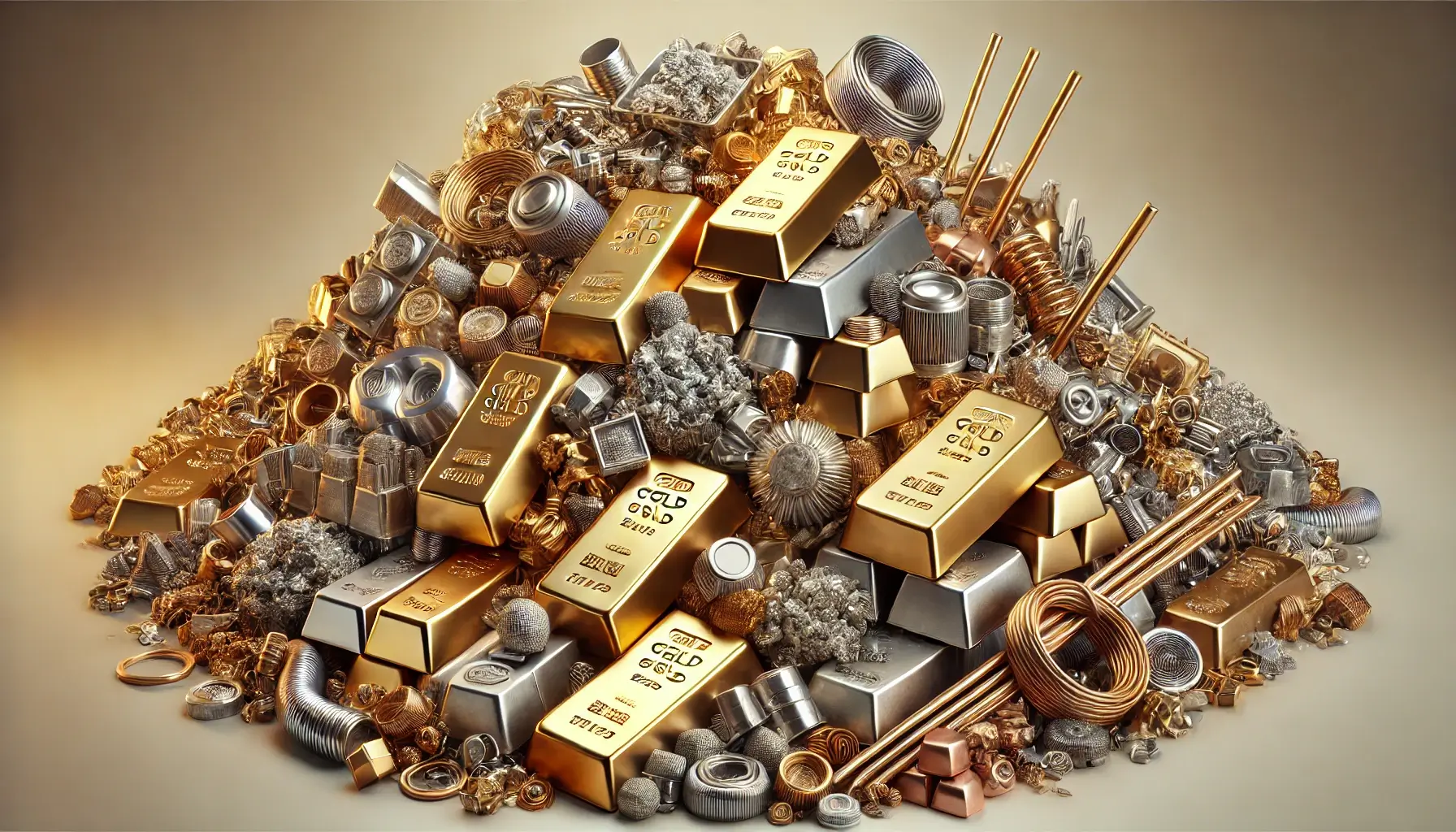
Complete List of Metals
1. Ferrous Metals
1.1 Iron (Fe)
- Description: A base metal used to produce steel, characterized by its strength and abundance.
- Sound: Produces a low, resonant clang when struck.
- Uses: Building structures, tools, vehicles, cookware.
- Industries: Construction, automotive, manufacturing.
- Recycling: Collected, melted down, and reformed into new products.
- Fact: Iron makes up about 5% of the Earth’s crust and is one of the most abundant metals.
1.2 Steel (Alloy of Iron)
- Description: An alloy of iron and carbon known for its versatility.
- Sound: Sharp, ringing sound when struck.
- Uses: Appliances, pipelines, bridges, machinery.
- Industries: Construction, engineering, manufacturing.
- Recycling: Crushed, melted, and rolled into sheets or bars.
- Fact: Steel is the most recycled material globally, with a 90% recycling rate.
1.3 Cast Iron (Alloy of Iron and Carbon)
- Description: A brittle yet durable alloy used for heavy-duty applications.
- Sound: Dull thud when struck.
- Uses: Cookware, engine parts, pipes.
- Industries: Automotive, plumbing, industrial machinery.
- Recycling: Broken into smaller pieces, melted, and cast into molds.
- Fact: Cast iron is fully recyclable and can be re-used indefinitely.
1.4 Wrought Iron
- Description: Malleable iron commonly used for decorative purposes.
- Sound: Mellow clang when struck.
- Uses: Fences, gates, vintage furniture.
- Industries: Architecture, construction, design.
- Recycling: Melted and used in decorative applications or mixed into steel.
- Fact: Resistant to corrosion, making it ideal for outdoor uses.
1.5 Tin (Sn)
- Description: A malleable metal often used for coatings.
- Sound: Soft, high-pitched ping.
- Uses: Food packaging, solder, alloys.
- Industries: Electronics, manufacturing.
- Recycling: Extracted from tin-coated steel and reused.
- Fact: Tin has been used for over 5,000 years in alloys like bronze.
2. Non-Ferrous Metals
2.1 Aluminum (Al)
- Description: Lightweight, corrosion-resistant, and widely used.
- Sound: Hollow, metallic ping when struck.
- Uses: Cans, car parts, airplanes, electronics.
- Industries: Packaging, automotive, aerospace.
- Recycling: Crushed, shredded, melted, and reformed into sheets or bars.
- Fact: Recycling aluminum saves up to 95% of the energy required for primary production.
2.2 Copper (Cu)
- Description: A highly conductive and malleable metal.
- Sound: Mellow, resonant ring when struck.
- Uses: Electrical wiring, plumbing, motors.
- Industries: Electrical, construction, manufacturing.
- Recycling: Stripped, melted, and purified for reuse in electronics and pipes.
- Fact: Copper can be recycled indefinitely without losing quality.
2.3 Brass (Alloy of Copper and Zinc)
- Description: Durable alloy with a golden color.
- Sound: Sharp, bright ring.
- Uses: Musical instruments, fixtures, fittings.
- Industries: Plumbing, manufacturing, arts.
- Recycling: Melted and re-alloyed into new brass products.
- Fact: Brass is valued for its resistance to tarnishing.
2.4 Zinc (Zn)
- Description: Corrosion-resistant metal often used in coatings.
- Sound: Muffled, low-pitched clang.
- Uses: Galvanized steel, roofing, batteries.
- Industries: Construction, automotive, electronics.
- Recycling: Extracted from coatings or batteries, melted, and reused.
- Fact: 30% of zinc production comes from recycled materials.
2.5 Lead (Pb)
- Description: Dense, soft, and malleable.
- Sound: Dull, muted thud.
- Uses: Batteries, radiation shields, pipes.
- Industries: Energy storage, healthcare, construction.
- Recycling: Smelted from batteries and purified for reuse.
- Fact: Over 80% of lead usage is in lead-acid batteries, which are highly recyclable.
2.6 Nickel (Ni)
- Description: Versatile, corrosion-resistant metal.
- Sound: Metallic, slightly dull ring.
- Uses: Stainless steel, batteries, coins.
- Industries: Energy, manufacturing, construction.
- Recycling: Melted and separated during stainless steel recycling.
- Fact: 68% of nickel is used in stainless steel production.
2.8 Titanium (Ti)
- Description: A strong, lightweight metal resistant to corrosion.
- Sound: Sharp, ringing clang when struck.
- Uses: Aerospace components, medical implants, bicycles.
- Industries: Aerospace, medical, sporting goods.
- Recycling: Separated, melted, and repurposed into industrial or medical products.
- Fact: Titanium is twice as strong as aluminum and 45% lighter than steel.
2.9 Cobalt (Co)
- Description: A hard, magnetic metal often alloyed with other materials.
- Sound: Clear, metallic ring.
- Uses: Batteries, magnets, superalloys.
- Industries: Energy, electronics, aerospace.
- Recycling: Extracted from used batteries and superalloy scrap.
- Fact: Over 60% of cobalt is used in rechargeable batteries for electric vehicles and electronics.
2.10 Magnesium (Mg)
- Description: Lightweight metal with high strength-to-weight ratio.
- Sound: Dull thud when struck.
- Uses: Electronics, car parts, aerospace components.
- Industries: Automotive, aerospace, electronics.
- Recycling: Shredded, melted, and reformed into ingots for reuse.
- Fact: Magnesium is 75% lighter than steel, making it ideal for weight-sensitive applications.
2.11 Chromium (Cr)
- Description: Shiny, hard metal used in stainless steel and coatings.
- Sound: Bright, metallic ping.
- Uses: Chrome plating, stainless steel, dyes.
- Industries: Automotive, construction, manufacturing.
- Recycling: Recovered during the stainless steel recycling process.
- Fact: Chromium is what gives stainless steel its corrosion resistance.
2.12 Bismuth (Bi)
- Description: Dense, brittle metal often used as a lead substitute.
- Sound: Soft, dull clink.
- Uses: Cosmetics, medicines, alloys.
- Industries: Healthcare, manufacturing, consumer goods.
- Recycling: Extracted from lead recycling streams.
- Fact: Bismuth is non-toxic, making it a safer alternative to lead in various applications.
2.13 Gallium (Ga)
- Description: Soft, silvery metal that melts at body temperature.
- Sound: Minimal sound due to its softness.
- Uses: Semiconductors, LEDs, solar panels.
- Industries: Electronics, renewable energy.
- Recycling: Recovered from electronic waste and solar panel scrap.
- Fact: Gallium is critical for advanced LED and solar technologies.
2.14 Indium (In)
- Description: Soft, malleable metal used in touchscreens and displays.
- Sound: Quiet, dull thud.
- Uses: Flat-panel displays, solar cells, solder.
- Industries: Electronics, renewable energy, manufacturing.
- Recycling: Extracted from electronic waste and industrial residues.
- Fact: Indium is a vital component of transparent conductive coatings.
2.15 Lithium (Li)
- Description: Lightest metal used primarily in rechargeable batteries.
- Sound: Soft metallic clang.
- Uses: Batteries, glass, ceramics.
- Industries: Energy storage, consumer electronics.
- Recycling: Recovered through battery recycling processes.
- Fact: Lithium is key to the energy transition due to its role in electric vehicles.
2.16 Antimony (Sb)
- Description: Brittle, shiny metal used in flame retardants.
- Sound: Soft, high-pitched clink.
- Uses: Alloys, flame-proof materials, semiconductors.
- Industries: Construction, electronics.
- Recycling: Extracted from industrial by-products.
- Fact: Antimony strengthens lead for use in batteries and bullets.
2.17 Beryllium (Be)
- Description: Lightweight, strong, and corrosion-resistant.
- Sound: High-pitched metallic ping.
- Uses: Aerospace components, X-ray windows, electronics.
- Industries: Aerospace, healthcare, electronics.
- Recycling: Recovered from industrial scrap and used tools.
- Fact: Beryllium is 6 times stronger than steel by weight.
3. Precious Metals
3.1 Gold (Au)
- Description: Dense, malleable, corrosion-resistant metal.
- Sound: Soft, dull thud.
- Uses: Jewelry, electronics, dentistry.
- Industries: Electronics, jewelry, medical.
- Recycling: Extracted from circuit boards and electronics.
- Fact: Recycling one ton of cell phones yields more gold than one ton of gold ore.
3.2 Silver (Ag)
- Description: Highly conductive and reflective metal.
- Sound: Bright, clear ring.
- Uses: Jewelry, solar panels, electronics.
- Industries: Renewable energy, electronics.
- Recycling: Extracted from electronic waste and industrial residues.
- Fact: Silver is essential in photovoltaic cells for solar energy production.
3.3 Platinum (Pt)
- Description: Dense, corrosion-resistant, and highly valuable metal.
- Sound: Soft, resonant clink.
- Uses: Catalytic converters, jewelry, medical devices.
- Industries: Automotive, jewelry, healthcare.
- Recycling: Extracted from catalytic converters and medical equipment.
- Fact: Platinum is 30 times rarer than gold and critical in reducing vehicle emissions.
3.4 Palladium (Pd)
- Description: Shiny, silvery-white metal used in electronics and automotive industries.
- Sound: Clear, metallic ping.
- Uses: Catalytic converters, fuel cells, electronics.
- Industries: Automotive, energy, electronics.
- Recycling: Recovered from catalytic converters and industrial waste.
- Fact: Palladium is vital in hydrogen fuel cells and green energy technologies.
3.5 Rhodium (Rh)
- Description: Rare, corrosion-resistant metal with high reflectivity.
- Sound: Bright, sharp metallic ring.
- Uses: Catalytic converters, jewelry plating, mirrors.
- Industries: Automotive, luxury goods, optics.
- Recycling: Extracted from catalytic converters and industrial by-products.
- Fact: Rhodium is the most expensive precious metal, valued for its durability in harsh conditions.
4. Rare and Critical Metals
4.1 Tungsten (W)
- Description: Extremely dense metal with the highest melting point of any element.
- Sound: Low, dense metallic thud.
- Uses: Filaments, cutting tools, military applications.
- Industries: Manufacturing, military, electronics.
- Recycling: Recovered from worn-out tools and industrial waste.
- Fact: Tungsten’s melting point is 3,422°C, making it essential for high-temperature applications.
4.2 Hafnium (Hf)
- Description: Corrosion-resistant metal used in nuclear reactors and aerospace.
- Sound: Soft, resonant ping.
- Uses: Control rods, jet engines, semiconductors.
- Industries: Aerospace, nuclear energy, electronics.
- Recycling: Extracted from zirconium refining processes.
- Fact: Hafnium absorbs neutrons efficiently, making it critical in nuclear power plants.
4.3 Molybdenum (Mo)
- Description: Strong metal that withstands high temperatures.
- Sound: Metallic ring with a deep tone.
- Uses: Aircraft parts, oil pipelines, construction.
- Industries: Aerospace, energy, manufacturing.
- Recycling: Recovered from industrial tools and scrap.
- Fact: Molybdenum is often alloyed with steel to improve its strength and corrosion resistance.
4.4 Rare Earth Elements (REEs)
- Description: A group of 17 elements critical for high-tech applications.
- Sound: Varies based on alloy composition.
- Uses: Magnets, batteries, electronics, wind turbines.
- Industries: Renewable energy, electronics, automotive.
- Recycling: Extracted from electronic waste and magnets.
- Fact: Rare earths are vital for green technologies like electric vehicles and wind power.
4.5 Vanadium (V)
- Description: A soft, ductile metal used to strengthen alloys.
- Sound: Sharp metallic clang.
- Uses: Steel reinforcement, aerospace tools, batteries.
- Industries: Construction, aerospace, energy.
- Recycling: Extracted from steel and industrial by-products.
- Fact: Vanadium redox batteries are a promising technology for renewable energy storage.
4.6 Scandium (Sc)
- Description: Lightweight metal that improves the strength of aluminum alloys.
- Sound: Soft metallic ping.
- Uses: Aerospace components, sporting goods, lighting.
- Industries: Aerospace, sports equipment, lighting.
- Recycling: Recovered from industrial waste streams.
- Fact: Scandium-aluminum alloys are 20% stronger than traditional aluminum alloys.
4.7 Zirconium (Zr)
- Description: A corrosion-resistant metal used in nuclear power and ceramics.
- Sound: Low metallic ring.
- Uses: Nuclear reactors, ceramics, surgical tools.
- Industries: Nuclear energy, healthcare, manufacturing.
- Recycling: Extracted from industrial processes involving zircon sand.
- Fact: Zirconium does not absorb neutrons, making it ideal for nuclear fuel rods.
4.8 Rhenium (Re)
- Description: Dense, heat-resistant metal used in jet engines and thermocouples.
- Sound: Dull, heavy clink.
- Uses: Jet engines, catalysts, temperature sensors.
- Industries: Aerospace, energy, petrochemical.
- Recycling: Recovered from superalloys and catalytic converters.
- Fact: Rhenium can withstand temperatures above 3,000°C, making it essential for high-temperature applications.
5. Additional Metals
5.1 Francium (Fr)
- Description: Highly radioactive and unstable alkali metal.
- Sound: N/A (radioactive decay).
- Uses: Research purposes only.
- Industries: Scientific research.
- Recycling: None due to extreme rarity.
- Fact: Francium is the rarest naturally occurring element on Earth.
5.2 Radium (Ra)
- Description: Radioactive metal formerly used in luminous paints.
- Sound: N/A (radioactive decay).
- Uses: Limited to medical and research contexts.
- Industries: Medical, scientific research.
- Recycling: Rarely recycled due to safety concerns.
- Fact: Radium’s discovery led to advances in cancer treatment techniques.
5.3 Polonium (Po)
- Description: A highly radioactive post-transition metal.
- Sound: N/A (radioactive decay, not handled in traditional ways).
- Uses: Industrial anti-static devices, nuclear applications.
- Industries: Scientific research, industrial manufacturing.
- Recycling: Rarely recycled due to its radioactive properties and limited applications.
- Fact: Polonium emits alpha particles and was famously discovered by Marie Curie in 1898.
5.4 Actinium (Ac)
- Description: A silvery radioactive metal found in trace amounts in uranium ore.
- Sound: N/A (radioactive decay).
- Uses: Used in radiation therapy and as a neutron source.
- Industries: Medical research, nuclear energy.
- Recycling: Limited recycling in specialized nuclear research facilities.
- Fact: Actinium glows faintly in the dark due to its radioactivity.
5.5 Protactinium (Pa)
- Description: A dense, radioactive actinide metal.
- Sound: N/A (radioactive decay).
- Uses: Limited to nuclear research.
- Industries: Scientific research.
- Recycling: Not recycled due to rarity and radioactive hazards.
- Fact: Protactinium is extremely rare, found in uranium ores at a concentration of less than 0.1 parts per million.
5.6 Francium (Fr)
- Description: An alkali metal known for being highly unstable and radioactive.
- Sound: N/A (radioactive decay).
- Uses: Exclusively for scientific research.
- Industries: Research laboratories.
- Recycling: Not recycled due to its extreme instability and rarity.
- Fact: Francium is so rare that its total amount on Earth is estimated to weigh less than one ounce at any time.
5.7 Radium (Ra)
- Description: A naturally occurring radioactive metal, formerly used in luminous paint.
- Sound: N/A (radioactive decay).
- Uses: Medical research, radiation therapy.
- Industries: Healthcare, scientific research.
- Recycling: Not commonly recycled; radioactive waste disposal protocols apply.
- Fact: Radium was once used in watch dials, but its use has been discontinued due to health risks.
6. Rare Earth Elements (Expanded)
Rare earth elements (REEs) are vital for modern technologies, including green energy, electronics, and advanced manufacturing.
6.1 Europium (Eu)
- Description: A soft, silvery metal used in fluorescent lamps and LEDs.
- Sound: Dull metallic thud.
- Uses: Energy-efficient lighting, color TV phosphors.
- Industries: Electronics, renewable energy.
- Recycling: Extracted from e-waste, such as screens and lamps.
- Fact: Europium provides the red color in LED and LCD displays.
6.2 Dysprosium (Dy)
- Description: A hard, corrosion-resistant metal used in magnets.
- Sound: Metallic ping.
- Uses: High-performance magnets, wind turbines, electric vehicles.
- Industries: Renewable energy, automotive.
- Recycling: Recovered from magnets in electronic waste.
- Fact: Dysprosium enhances the heat resistance of magnets in electric motors.
6.3 Terbium (Tb)
- Description: A silvery rare earth metal used in energy-efficient lighting.
- Sound: Dull metallic thud.
- Uses: Fluorescent lamps, magnets, phosphors.
- Industries: Lighting, electronics.
- Recycling: Extracted from lighting and electronic components.
- Fact: Terbium is vital for green technology and low-energy light sources.
6.4 Ytterbium (Yb)
- Description: A soft metal used in fiber optic technology.
- Sound: Muffled metallic ping.
- Uses: Lasers, electronics, medical imaging.
- Industries: Healthcare, telecommunications.
- Recycling: Rarely recycled; extracted from specialized electronics.
- Fact: Ytterbium is used in highly precise atomic clocks.
6.5 Holmium (Ho)
- Description: A rare earth metal used in magnets and nuclear reactors.
- Sound: Low-pitched metallic ring.
- Uses: High-strength magnets, nuclear control rods.
- Industries: Renewable energy, nuclear energy.
- Recycling: Limited; recovered from magnets and industrial waste.
- Fact: Holmium has the highest magnetic strength of any element.
Super Heavy Elements
Super heavy elements are synthetic, radioactive elements created in laboratories. They do not exist naturally and are produced in particle accelerators through nuclear fusion processes. These elements are extremely unstable and decay rapidly, often within fractions of a second.
7.1 Rutherfordium (Rf)
- Description: A synthetic element named after physicist Ernest Rutherford. It is highly radioactive.
- Sound: N/A (exists only in atomic form).
- Uses: Limited to scientific research on atomic structure and nuclear reactions.
- Industries: Research laboratories.
- Recycling: None; produced in minimal quantities.
- Fact: Rutherfordium was discovered in 1969 and is one of the first transactinides.
7.2 Dubnium (Db)
- Description: A synthetic, highly radioactive metal named after the Joint Institute for Nuclear Research in Dubna, Russia.
- Sound: N/A (exists only in trace amounts).
- Uses: Used exclusively in scientific experiments to study its properties.
- Industries: Nuclear research.
- Recycling: None; unstable and created in minuscule amounts.
- Fact: Dubnium has no stable isotopes, with its longest-lived isotope lasting just over a day.
7.3 Seaborgium (Sg)
- Description: A radioactive metal named after chemist Glenn T. Seaborg.
- Sound: N/A (exists momentarily before decay).
- Uses: Limited to research on nuclear reactions and chemical behavior.
- Industries: Research institutions.
- Recycling: Not applicable due to its synthetic nature.
- Fact: Seaborgium was discovered in 1974 and is part of the group 6 transition metals.
7.4 Bohrium (Bh)
- Description: A synthetic element named after physicist Niels Bohr.
- Sound: N/A (highly unstable and short-lived).
- Uses: Used in experimental nuclear physics research.
- Industries: Nuclear research.
- Recycling: None; production is limited to atomic-level experiments.
- Fact: Bohrium’s isotopes decay within seconds, making its chemical properties difficult to study.
7.5 Hassium (Hs)
- Description: A super heavy synthetic element named after the German state of Hesse.
- Sound: N/A (atomic-level existence).
- Uses: Primarily for studying its nuclear structure and reactions.
- Industries: Research laboratories.
- Recycling: Not feasible due to its instability.
- Fact: Hassium belongs to group 8 of the periodic table, sharing similarities with osmium.
7.6 Meitnerium (Mt)
- Description: A synthetic element named after physicist Lise Meitner.
- Sound: N/A (produced in trace amounts).
- Uses: Used in experimental physics for understanding nuclear properties.
- Industries: Scientific research.
- Recycling: Not possible due to its short half-life.
- Fact: Meitnerium was discovered in 1982, and its longest-lived isotope lasts only seconds.
7.7 Darmstadtium (Ds)
- Description: A radioactive metal named after the city of Darmstadt, Germany.
- Sound: N/A (atomic-level presence).
- Uses: Studied to explore its position in group 10 of the periodic table.
- Industries: Nuclear and atomic research.
- Recycling: Not applicable due to its rapid decay.
- Fact: Darmstadtium was first synthesized in 1994 and has properties predicted to be similar to platinum.
7.8 Roentgenium (Rg)
- Description: A synthetic element named after Wilhelm Conrad Roentgen, the discoverer of X-rays.
- Sound: N/A (exists only for milliseconds).
- Uses: Research into atomic and nuclear behavior.
- Industries: Research laboratories.
- Recycling: None; it decays too quickly for practical applications.
- Fact: Roentgenium is predicted to behave like gold due to its position in group 11.
7.9 Copernicium (Cn)
- Description: A radioactive, gaseous element named after astronomer Nicolaus Copernicus.
- Sound: N/A (produced in atomic-scale quantities).
- Uses: Investigated for its chemical properties.
- Industries: Research only.
- Recycling: Not feasible.
- Fact: Copernicium is the heaviest element in group 12, similar to mercury.
7.10 Nihonium (Nh)
- Description: A synthetic element named after Japan (Nihon).
- Sound: N/A (extremely unstable).
- Uses: Researching its placement in the periodic table.
- Industries: Scientific laboratories.
- Recycling: Not possible.
- Fact: Nihonium is the first element discovered in Asia and belongs to group 13.
7.11 Flerovium (Fl)
- Description: A synthetic element named after physicist Georgy Flerov.
- Sound: N/A (exists for milliseconds).
- Uses: Limited to theoretical studies of super heavy elements.
- Industries: Research.
- Recycling: Not applicable.
- Fact: Flerovium’s predicted properties suggest it may behave like lead or tin.
7.12 Moscovium (Mc)
- Description: A radioactive element named after Moscow, Russia.
- Sound: N/A (unstable atomic presence).
- Uses: Studied for nuclear behavior.
- Industries: Research facilities.
- Recycling: None.
- Fact: Moscovium was discovered in 2003 and belongs to group 15 of the periodic table.
7.13 Livermorium (Lv)
- Description: A super heavy element named after the Lawrence Livermore National Laboratory.
- Sound: N/A (extremely unstable).
- Uses: Experimental research only.
- Industries: Research laboratories.
- Recycling: Not feasible.
- Fact: Livermorium decays in milliseconds, providing limited experimental data.
7.14 Tennessine (Ts)
- Description: Named after Tennessee, USA, where it was discovered.
- Sound: N/A (short-lived existence).
- Uses: Studying atomic interactions in group 17.
- Industries: Research institutions.
- Recycling: Not possible.
- Fact: Tennessine is the heaviest halogen and shares properties with iodine.
7.15 Oganesson (Og)
- Description: Named after nuclear physicist Yuri Oganessian.
- Sound: N/A (exists for microseconds).
- Uses: Research into the limits of the periodic table.
- Industries: Scientific research.
- Recycling: Not feasible.
- Fact: Oganesson is theorized to be a gas at room temperature but behaves unpredictably due to relativistic effects.
For more on our complete list of metals follow us on social media to stay up-to-date with the latest news, offers, and exciting giveaways! Connect with us on Facebook, Instagram, and Google to learn more about scrap metal recycling, exclusive deals, and much more. Don’t miss out—join our community today!